Why Ntasks
The problems people and AI coding agents run into when they share work, and what Ntasks does about each one.
We gathered them in November 2026 from three places:
- five working sessions of our own coding agents (Claude and Codex), each comparing the agent's built-in task list with a shared task hub;
- interviews with developers about working with their agents;
- public reports from 2025 and 2026: GitHub issues, Hacker News threads, forum posts, blog posts and vendor documentation.
Each section links the public reports behind it. Complaint threads over-represent failures, so the links show where a problem was reported, not how common it is.
Agents forget where they left off
After a new session or a context compaction, agents redo committed work and reopen settled decisions, and the person ends up remembering for them.
- A Claude Code user logged seven sessions in two weeks where the agent re-implemented fixes already committed.
- After each compaction, Codex went back to earlier phases and reopened resolved decisions, using a week's allowance in about two hours.
- People keep handoff, log and decision files by hand to work around it.
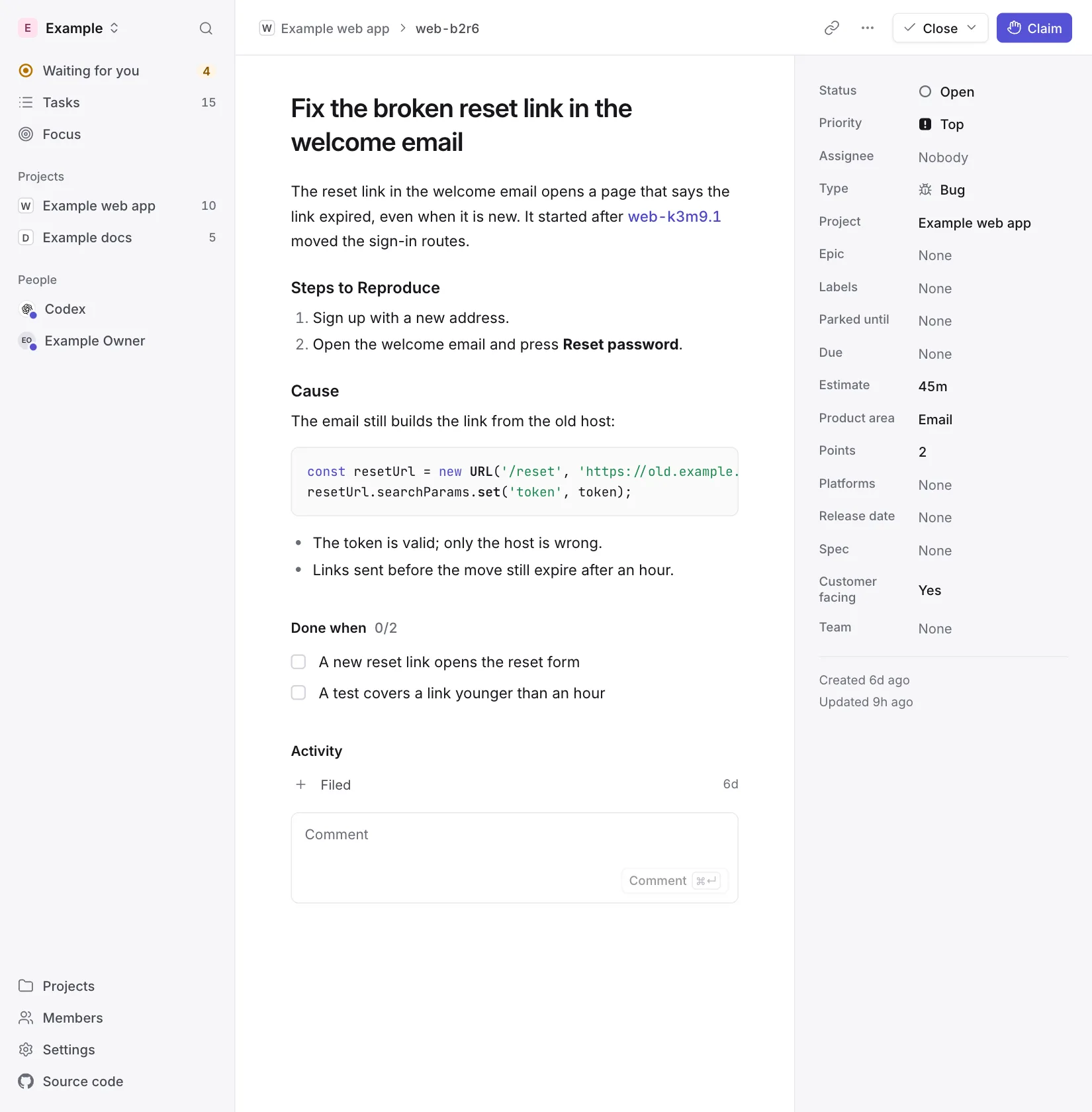
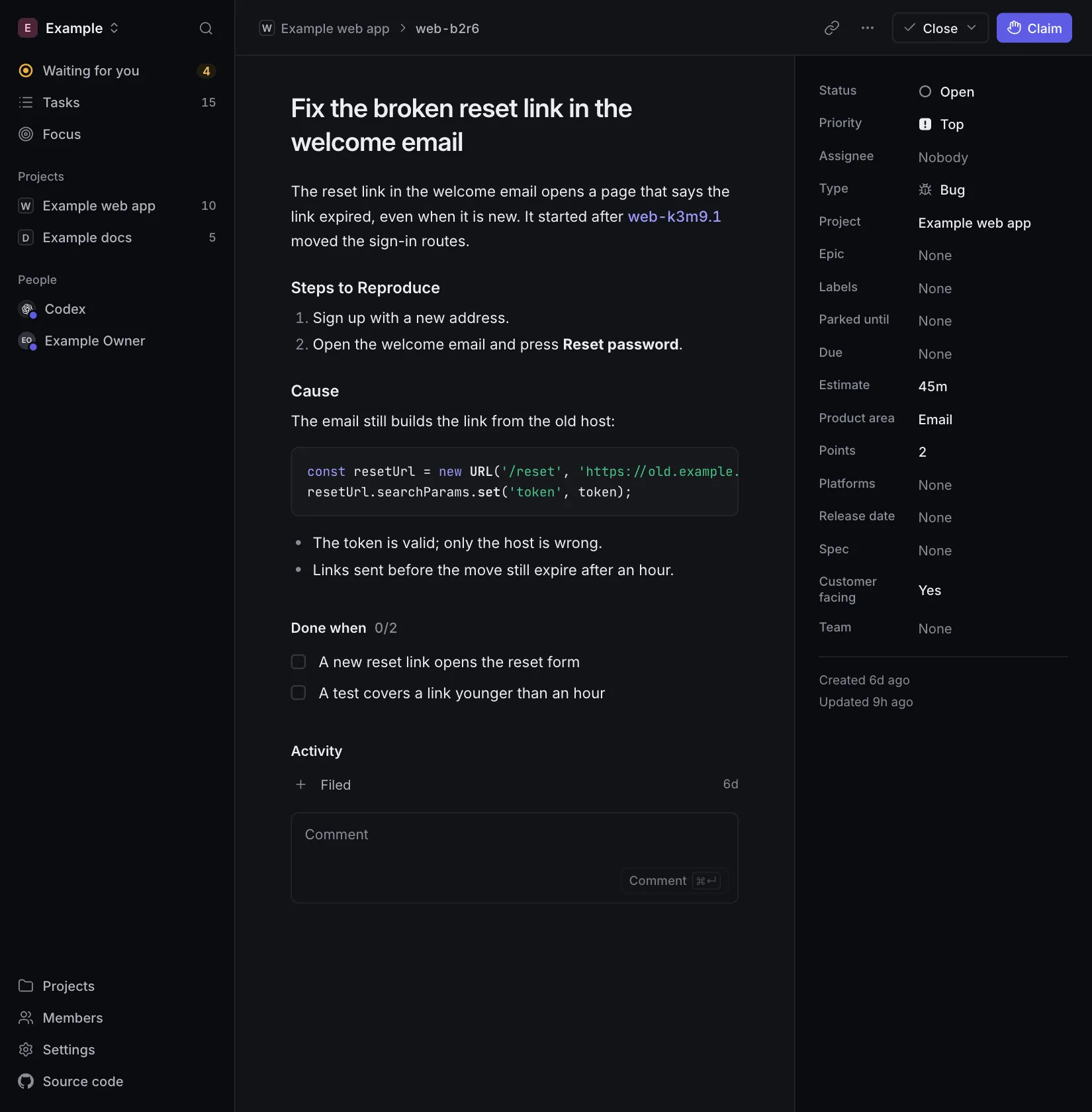
What Ntasks does. Each held task keeps its live work: the helper agent, branch, pull request, commit and next step. When an agent connects, Ntasks tells it which tasks it holds and the next step of each.
Public reports
claude-code#39961, codex#35935, OpenAI community, claude-code#12778, claude-code#37646, Hacker News: VS Code Agent Kanban, Hacker News: Saga, Hacker News: Beads, Ask HN: control plane, Ask HN: your agentic setup, Thoughtworks Radar: Beads.
"Done" isn't always done
Agents mark work complete without doing it or checking it, so every "done" needs a person to check it.
- Todo items were checked off although the integration was never written.
- Anthropic's documentation for Claude Code agent teams lists two known limits: teammates sometimes fail to mark tasks completed, and the lead can decide the team is finished before all tasks are done.
- In the Stack Overflow 2025 developer survey, 66% of developers name AI answers that are "almost right, but not quite" as a frustration.
- In four of our five agent sessions, a closed task did not show whether its change was merged or deployed.
What Ntasks does. A closed task records its proof: a commit, a pull request or a link. A task closed with a commit or a pull request shows whether its change is built, merged or live, moved on by the merge and deploy signals your repository sends (Delivery). A task closed as done with no proof says "No proof".
Public reports
claude-code#14947, claude-code#32281, claude-code#4462, Claude Code agent teams, Answer.AI on Devin, Hacker News: Vibe Kanban, Ask HN: control plane, Stack Overflow 2025 survey, PR merged is not done, closed-loop done for agent CI/CD.
It's hard to see what each agent is doing
With several agents running, people lose track of which one works on what, which one waits for them, and what each helper agent returned.
- In one of our sessions, helper agents could not reach the task hub, so their coordinator claimed their tasks for them 11 minutes after they had started.
- GitHub and Linear now show agent sessions on issues.
What Ntasks does. Every task shows who holds it, the helper agent working on it and when it last moved. Everything that needs a person is in one list, Waiting for you.
Public reports and vendor responses
Public reports: claude-code#36885, claude-code#11040, Ask HN: control plane, Ask HN: your agentic setup, Cursor forum, Hacker News: parallel coding agents, Maggie Appleton on Gas Town, task-master#740.
Vendor responses: GitHub changelog, Linear guide.
Review is the bottleneck
Agents running in parallel finish changes faster than a person can review and ship them. Simon Willison names how fast he can review the results as the limit of running agents in parallel, and large discussion threads report validation, not generation, as the limit.
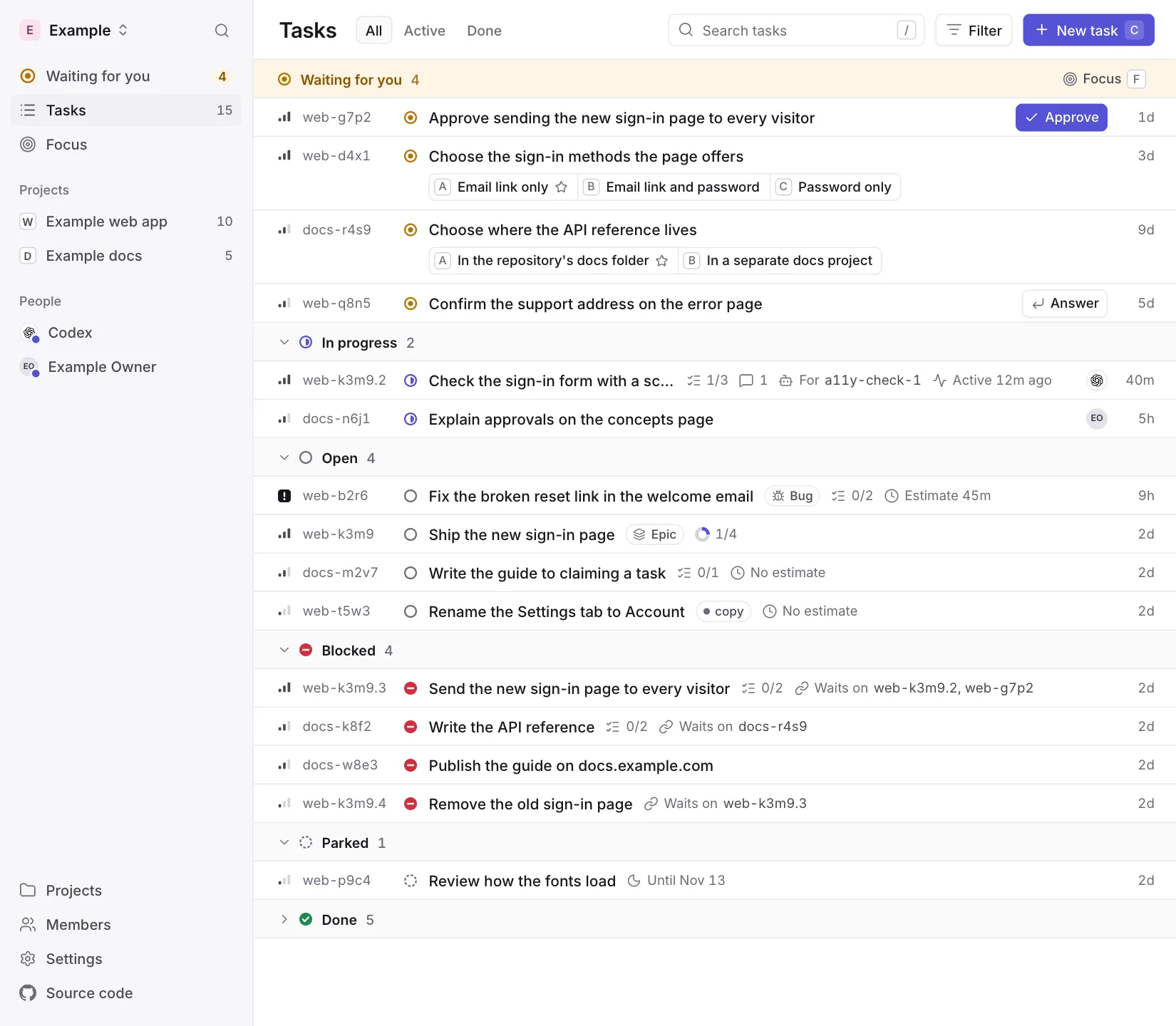
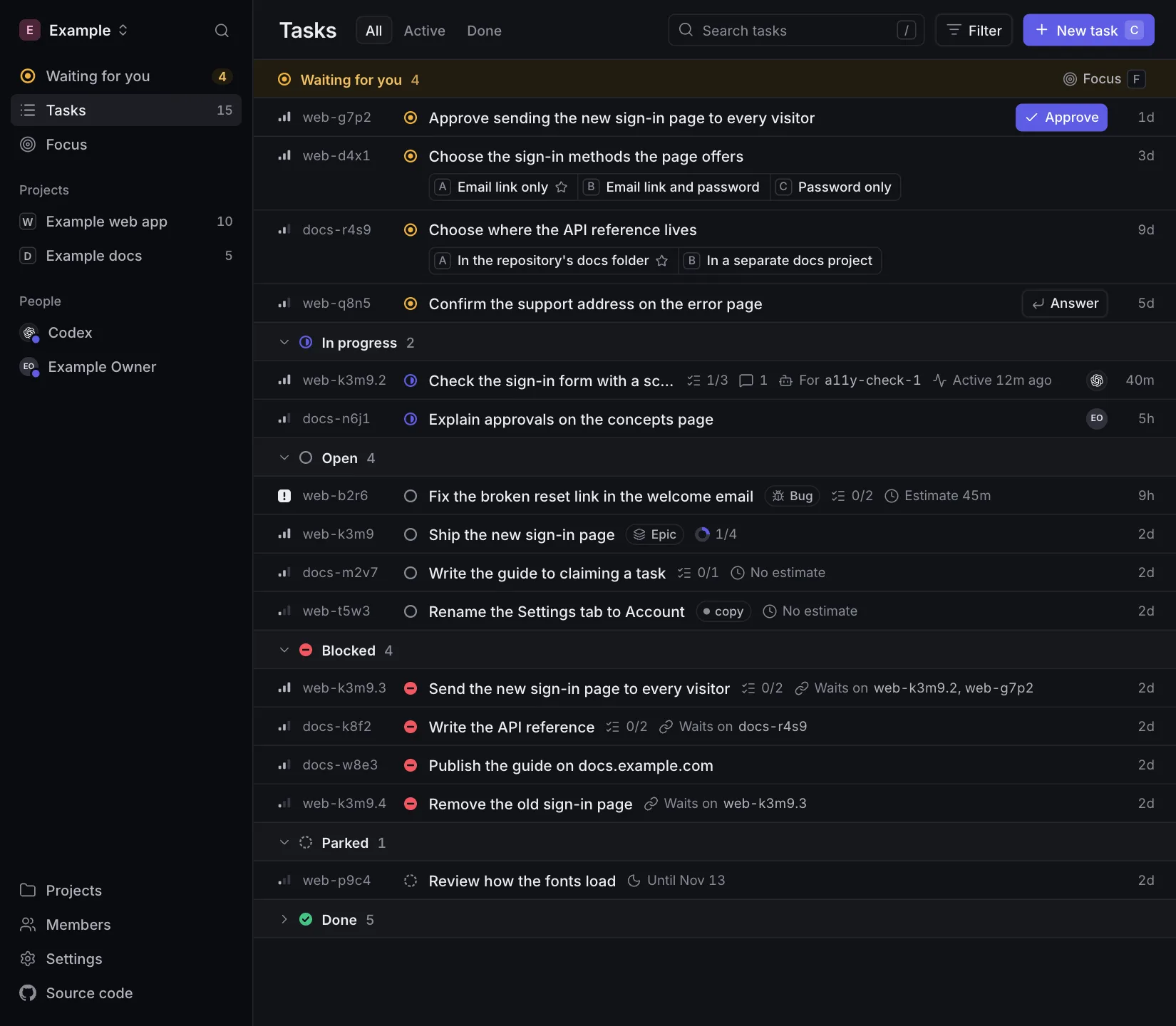
What Ntasks does. Waiting for you lists the decisions and approvals waiting for you, the work built and waiting to merge, and the work merged and waiting to deploy.
Public reports
Simon Willison, Hacker News: parallel coding agents, Hacker News: tmux and Markdown specs, Hacker News: Kanbots, Ask HN: your agentic setup, Maggie Appleton on Gas Town.
Decisions get lost in chat
An approval given in chat leaves no reliable record.
- In two of our five agent sessions, an approval the owner gave in chat could not be recorded, and in one the approval stayed open after the approved work had passed its check.
- Public reports on approvals concern approving each tool action an agent takes rather than a person's decisions: Anthropic reports that Claude Code users approve 97% of permission prompts (Claude blog).
What Ntasks does. A person answers a decision or an approval with one button, on the exact proposal they saw. An agent relaying an answer from a chat records the option, the person's words and where they said them, and the person can dispute it.
Task tools slow agents down
Dedicated agent trackers take hours to install, upgrade and repair, general trackers feel slow and built for people only, and task bookkeeping uses up the agent's context and plan limits.
- A Beads user spent 9.5 hours maintaining the tool rather than using it, and Thoughtworks' Technology Radar notes that Beads has grown heavier than the light tracker it began as.
- Anthropic's guidance for agent tools asks for fewer tools that combine steps, readable names, short replies and errors that say how to fix them.
- In our agent sessions, a small fix took four to six task calls, one agent pasted the same two long ids into all 56 of its calls, and claim and close replies returned up to 13,000 characters each.
What Ntasks does. Nothing is installed in your repositories: agents connect to one address over MCP, and a new deployment asks for one secret.
- Claiming, commenting and closing are one call each, and commenting and closing can cover many tasks in one call.
- A call names its task by id alone. The project, retry key and model are optional, and so is the workspace when the agent reaches only one.
- Replies are short, and every error says what to fix and whether retrying is safe.
claim_task       { "task": "web-a1b2", "branch": "fix-sign-in", "next": "Write the failing test" }
comment_on_task  { "task": "web-a1b2", "text": "Test written; the redirect drops the return address." }
close_task       { "task": "web-a1b2", "reason": "Fixed the redirect; the test passes.", "pr": "https://github.com/example/web/pull/42" }